If you’re building a startup, you don’t have time or budget to waste on random posts that go nowhere.
You need social media to do real work for you: validate demand, build a waitlist, attract early customers, and make your brand look like it belongs in the market.
This practical playbook breaks down social media marketing for startups into a clear launch plan: what to prioritize, which channels to pick first, what to post, and how to track if it’s working.
Use it as a checklist you can execute in weeks, not months—whether you’re a solo founder or a tiny team.
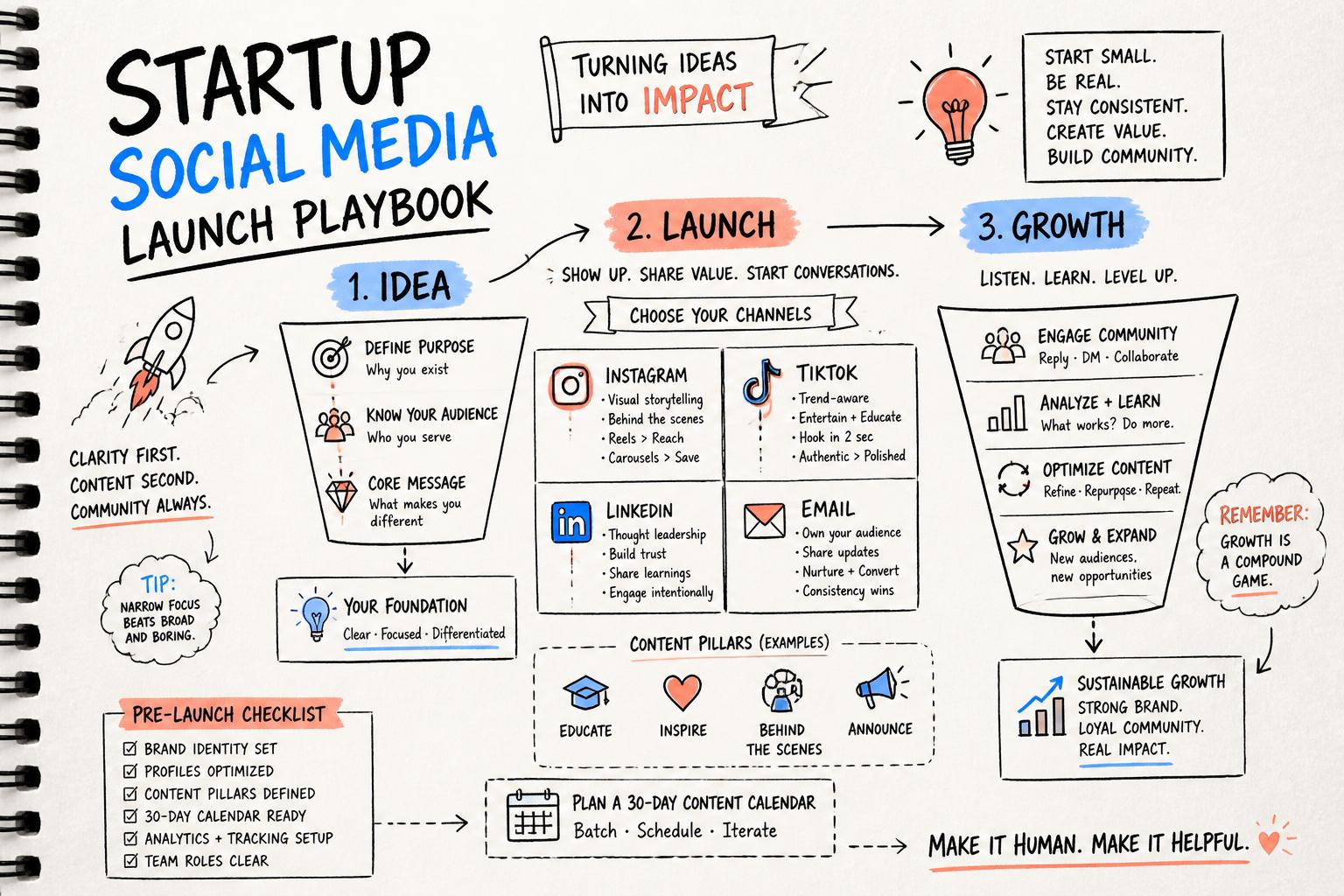
Step 1: Set sharp goals (so you don’t chase vanity metrics)
Before you open Canva or film a Reel, decide what your startup actually needs from social in the next 90 days.
For early-stage brands, that’s usually one (or a mix) of these:
Validate the idea – Are people even interested? Do they engage, comment, click?
Build an early audience – Email list, waitlist, followers who match your target customer.
Generate first sales or signups – Pre-orders, beta signups, discovery calls, demos.
Build credibility – So partners, investors, and customers take you seriously.
Pick one primary goal and one secondary goal for your first 90 days. Everything else is noise.
Examples:
Fintech app: Primary – waitlist signups; Secondary – investor credibility.
D2C skincare brand: Primary – first sales; Secondary – user-generated content and reviews.
B2B SaaS: Primary – demo requests; Secondary – build founder authority on LinkedIn.
Step 2: Get brutally clear on your audience and positioning
Startup social media strategy lives or dies on clarity: who you’re for, what problem you solve, and why you’re different.
Define a simple audience snapshot
Write this as if you’re describing one person:
Who they are: role, lifestyle, niche (e.g., “independent fashion designers in their first 3 years of business”)
What they want: outcomes, not features (e.g., “consistent sales without relying on marketplaces”)
What blocks them: frustrations, fears, constraints (e.g., “no time to market, don’t know what works”)
Craft a one-line positioning statement
Use this formula and repeat it across your bio, posts, and website:
We help [specific audience] achieve [outcome] without [pain] by [your unique angle].
Example: “We help early-stage fashion brands launch scroll-stopping visuals without in-house creative teams by combining strategy, content, and production under one roof.”
That clarity makes every future decision—channel, content, offers—much easier.
Step 3: Choose your first 1–3 channels (and ignore the rest)
The biggest mistake in social media marketing for startups is trying to be everywhere with mediocre content.
Instead, pick one primary growth channel and up to two support channels based on where your audience already hangs out and how they buy.
Quick channel cheat sheet for startups
Instagram: Best for visual, lifestyle, fashion, beauty, wellness, D2C, and creative-led brands. Great for community, storytelling, and social proof.
TikTok: Best for new brands willing to show behind-the-scenes, founder content, and educational or entertaining short-form videos.
LinkedIn: Best for B2B, high-ticket services, SaaS, or startups selling to professionals and decision-makers.
Twitter / X: Best for tech, builders, and founders who want to join industry conversations, share ideas, and build a personal brand.
Pinterest: Best for search-style, evergreen discovery for design, decor, fashion, wellness, and DIY brands.
For most early-stage brands, a focused mix looks like:
D2C / lifestyle: Instagram (primary) + TikTok (growth) + email list (owned).
B2B SaaS or services: LinkedIn (primary) + founder on Twitter/X (support) + email list.
Creators & personal brands: TikTok or Instagram Reels (primary) + newsletter (owned) + one community channel (Discord, Circle, etc.).
Step 4: Build a 30-day content calendar for startups
Now you know your goals and channels, you need a simple content calendar for startups—not a 20-tab spreadsheet you’ll abandon in week two.
The 4 content pillars every startup needs
Across any platform, rotate these four pillars:
1. Problem education – Teach your audience about the problem you solve and the stakes of ignoring it.
2. Solution & product – Show how your product/service works, with clear benefits and use cases.
3. Proof & trust – Share testimonials, case studies, user stories, press, and behind-the-scenes.
4. Brand & personality – Founder story, values, opinions, culture, and aesthetic.
Plan content by pillar, not by random ideas. This keeps you balanced and strategic.
Simple 30-day posting framework
Assume you’re posting 3x per week on your primary channel and 1–2x per week on support channels:
Week 1: Focus on problem education + founder/brand intro.
Week 2: Introduce solution and show real use cases.
Week 3: Share proof (social proof, testimonials, early results).
Week 4: Mix all four pillars, with stronger calls-to-action.
Track ideas in a simple table or doc with columns: Date, Channel, Content Pillar, Format, Caption Hook, CTA, Status.
Step 5: Instagram marketing for startups – a focused launch plan
Instagram is still the home base for many visual and consumer brands. Here’s a lean Instagram marketing for startups plan for your first 30–60 days.
Optimize your profile to convert, not just look pretty
Handle & name: Make it searchable (e.g., “Neu Tribe Studios – Brand & Social Studio”).
Bio: Use your positioning line + social proof + clear CTA (e.g., “Join the waitlist,” “Book a strategy call”).
Link: Use a single focused link (waitlist, launch page, Calendly, or Linktree-style page).
Highlights: Create 3–5: Start Here, Offer, Results, BTS, FAQs.
Your starter content mix on Instagram
Reels (2–3 per week): Education, “how we did this,” transformations, founder POV, fast tips.
Carousels (1–2 per week): Deep dives, frameworks, before/after, checklists.
Stories (3–5 days per week): Behind-the-scenes, polls, Q&A, mini case studies, launches.
Static posts: Use sparingly for key announcements, testimonials, or aesthetic anchors.
Instagram launch content sequence (first 10–15 posts)
Founding story: why you built this, who it’s for.
Problem carousel: “If you’re experiencing X, this is why.”
Reel: quick transformation or benefit in 5–7 seconds.
Offer breakdown: what you sell, who it’s for, outcomes.
Behind-the-scenes: building, packaging, designing, coding.
Social proof: early feedback, beta testimonials, screenshots.
Education carousel: “3 mistakes [your audience] makes with X.”
FAQ post: address common objections or hesitations.
Reel: founder talking to camera about a strong opinion in your niche.
Launch or CTA post: “Join the waitlist,” “Apply for beta,” “Book a call.”
Step 6: TikTok strategy for new brands – move fast and test
If you’re willing to show up on video, a strong TikTok strategy for new brands can get you in front of thousands of people quickly, even with a tiny following.
3 TikTok content types that work for startups
Build in public: Daily or weekly updates on what you’re building, decisions, wins, fails.
Teach what you know: Fast, specific tips related to your product’s problem space.
Show the product in context: Real use, packaging, unboxings, transformations, before/after.
Film in batches (1–2 hours per week), aim for 1–2 posts per day in the first 2–3 weeks, and watch what hooks and topics get traction.
Winning TikTok hooks for startups
Start your videos with a strong first line on-screen and in audio:
“I built a startup that helps [audience] do [outcome]. Here’s what I got wrong.”
“If you’re [specific audience], stop doing this…”
“POV: You’re trying to [outcome] but [frustration].”
“3 things I wish I knew before I tried to [solve problem].”
Keep editing simple: cut the fluff, add captions, and get to the value or story in the first 2–3 seconds.
Step 7: LinkedIn & founder-led marketing (especially for B2B)
For B2B, a founder’s personal brand can move faster than the company page. Treat LinkedIn as both a social channel and a distribution engine for your ideas.
Optimize your LinkedIn profile like a landing page
Headline: Use “I help [audience] achieve [outcome]” instead of job titles.
About section: Tell your story, the problem, and how you help—then add a clear CTA.
Featured section: Link to your site, case studies, or a lead magnet.
Simple LinkedIn posting rhythm
3 posts per week: mix of insights, short stories, and mini case studies.
Daily comments (10–15) on accounts your buyers follow.
1–2 DMs per day to warm leads, collaborators, or partners (never spammy).
Over time, this builds trust and inbound interest with exactly the people you want to work with.
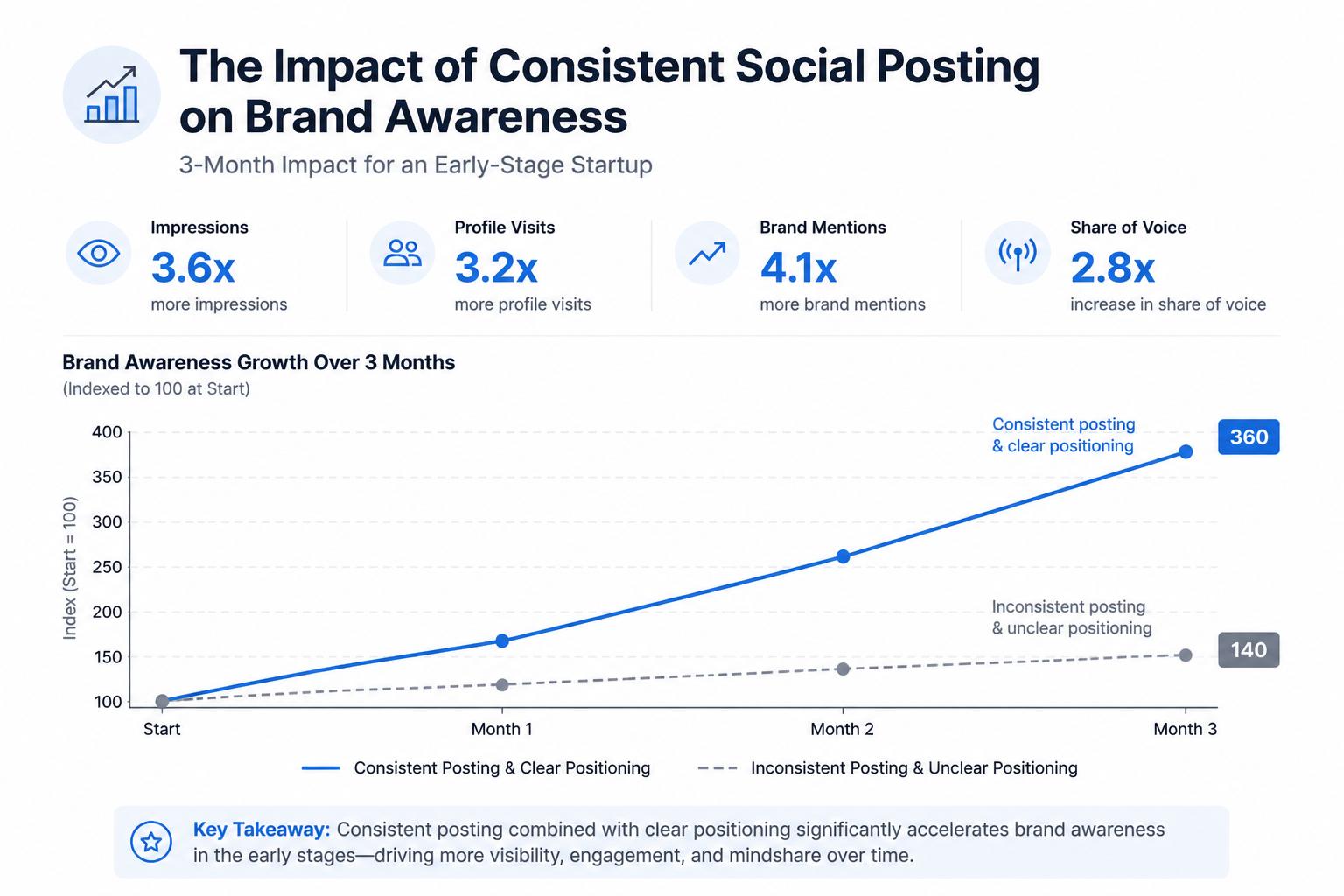
Let’s pull this together into a 4-week social media launch plan you can follow.
Week 0: Foundations
Clarify audience and positioning statement.
Choose 1–3 channels based on your startup type.
Set up profiles (bio, links, highlights, visuals).
Draft your first 10–15 posts per channel.
Week 1: Introduce the brand
Share founder story + why this problem matters.
Post educational content about the problem.
Add a soft CTA: join waitlist, follow for the journey, or sign up for early access.
Week 2: Show the solution
Demo or walkthrough of your product/service.
Share use cases and “day in the life with [your solution]”.
Answer objections in content: pricing, complexity, fit.
Week 3: Build proof and urgency
Share early testimonials, feedback, or beta results.
Show behind-the-scenes of shipping, building, or onboarding.
Introduce stronger CTAs: “Limited beta spots,” “Founding member pricing,” “Launch offer ends [date].”
Week 4: Optimize and double down
Review which posts got the most saves, shares, comments, and clicks.
Double down on those topics and formats.
Cut what flopped or refine the hook and creative.
Step 9: What to measure (and what to ignore) in the first 90 days
Early on, your goal is to learn what resonates and build momentum—not to hit arbitrary follower counts.
Metrics that matter for early stage brand awareness
Profile visits: Are your posts driving people to check you out?
Saves & shares: Strong indicators of content value and relevance.
Comments & DMs: Real conversations and questions from your ideal audience.
Click-throughs: To your waitlist, website, or booking page.
Leads & sales: Signups, pre-orders, demos booked.
Metrics to mostly ignore in the first 90 days:
Raw follower count without context.
Viral views from the wrong audience.
Perfect aesthetic at the expense of clarity and consistency.
According to Sprout Social’s breakdown of social media metrics, awareness, engagement, and conversion metrics should be prioritized based on your business stage and goals. For most startups, awareness and engagement are the first levers to focus on, with conversion layered in as your offer solidifies.
Step 10: Common startup social mistakes to avoid
Posting without a point: Aesthetic posts that don’t tie back to your offer or audience problem.
Copying big brands: They have budgets, teams, and awareness you don’t. You need scrappy, direct, and personal.
Inconsistent posting: Posting 10x in week one and disappearing for a month.
Outsourcing too early: If you don’t understand your own message, no agency or freelancer can save you.
Ignoring comments and DMs: Early on, every interaction is market research and relationship building.
Research from McKinsey on social media’s impact highlights that social isn’t just about reach—it’s about shaping consideration and loyalty. That only happens if you treat your audience like people, not metrics.
Step 11: When to bring in expert support
As your startup grows, there’s a point where DIY social starts capping your potential. Signs you’re ready for expert support:
You have product–market fit, but your visuals and messaging don’t reflect your value.
You’re getting traction, but content creation is eating the time you should spend on product or sales.
You’re ready to launch campaigns, collaborations, or paid media and need a cohesive creative direction.
A creative branding and digital studio like Neu Tribe Studios can help you:
Clarify your brand strategy and positioning so every post supports your growth goals.
Design a visual identity that actually stands out in feeds (not just another template).
Build a content system: from social media management services to photography, video, and campaign design.
Develop scroll-stopping Reels, TikToks, and launch campaigns that feel premium and on-brand.
If you’re ready to turn social from a time sink into a growth engine, it’s worth investing in partners who live and breathe social media marketing for startups, not just generic posting.
Step 12: Your 7-day action plan
To make this guide actionable, here’s a fast, focused 7-day implementation plan.
Social media won’t build your startup overnight—but with a focused plan, clear positioning, and consistent execution, it can become one of your most powerful early growth levers.
If you want a partner to help you design the strategy, visuals, and content that make your brand impossible to ignore, explore how Neu Tribe Studios supports founders with brand strategy, identity, and social media launch campaigns.
For further reading on best practices and benchmarks, you can explore Buffer’s guide to social media strategy and the HubSpot State of Marketing report to complement this startup-specific playbook.