Choosing a creative branding agency can either unlock your next stage of growth or drain time, budget, and momentum. The challenge isn’t just finding a “good” agency; it’s finding the right fit for your business model, stage, and goals.
This guide breaks down exactly how to evaluate agencies side by side, what criteria actually matter, and the red flags that signal an expensive mismatch. You’ll also get a ready-to-use list of questions to ask in your discovery calls so you can compare partners with confidence.
While examples here draw on how studios like Neu Tribe Studios work as a strategy-led, creative branding partner, the framework is designed so you can use it with any agency you’re considering.
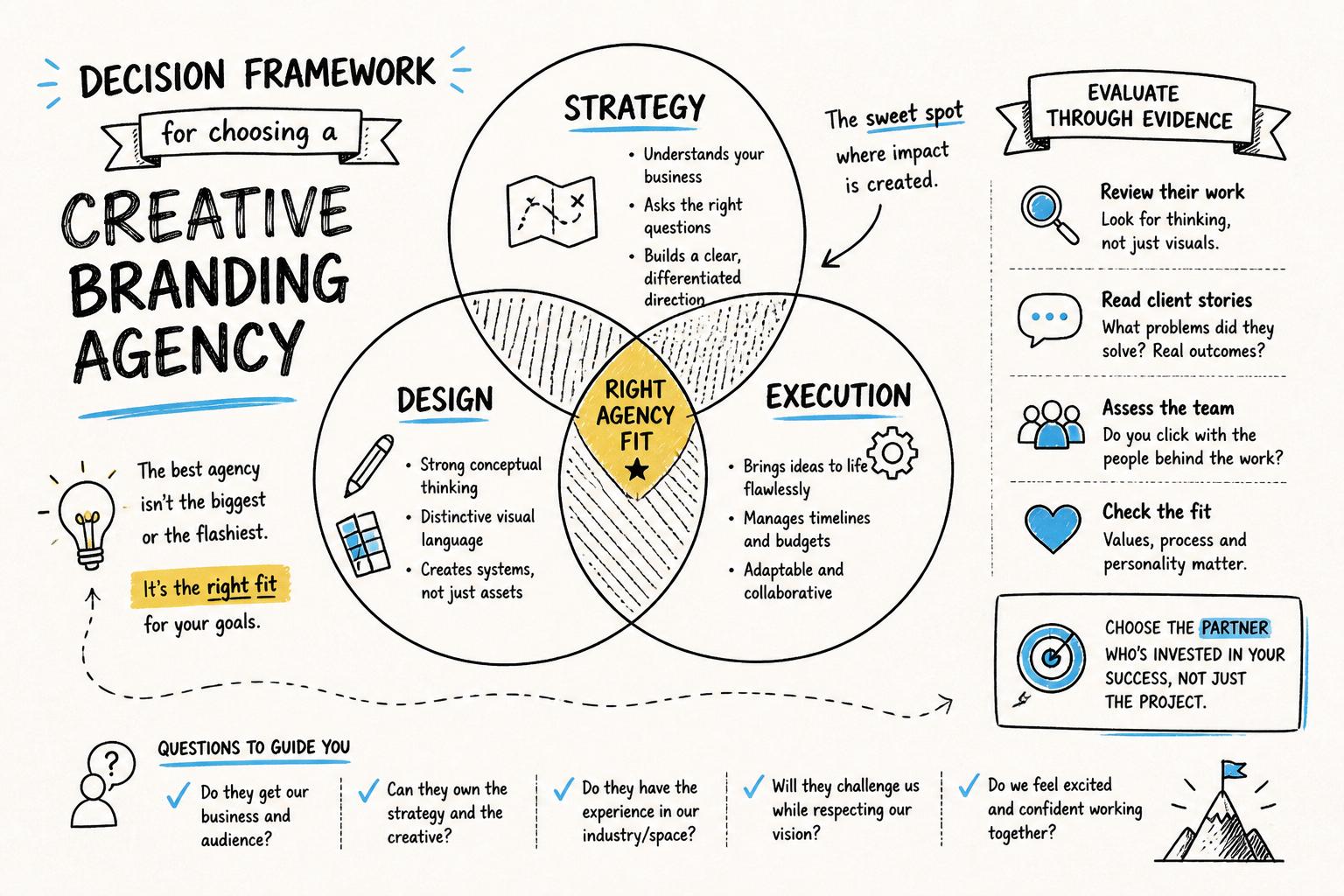
What “Choosing a Creative Branding Agency” Really Means
When you’re choosing a creative branding agency, you’re not just buying a logo or a fresh Instagram grid. You’re choosing a thinking partner who will:
Shape how your brand shows up in the market
Translate your vision into visuals, words, and experiences
Influence how investors, customers, and talent perceive you
That’s why the decision should be evaluated like any other strategic investment: based on fit, capability, and expected outcomes—not just aesthetics.
Step 1: Clarify What You Actually Need From a Branding Partner
Before comparing agencies, get brutally clear on your own context. This will narrow your shortlist and help you spot who’s truly equipped to help.
Identify your brand challenge
Most branding projects fall into one of these scenarios:
New launch: You need full brand strategy, naming, identity, website, and launch assets.
Rebrand: You’ve outgrown your look or positioning and need to realign with a new vision or audience.
Digital upgrade: Your brand is solid, but your website, content, or social presence isn’t reflecting it.
Campaign or product launch: You need a high-impact creative campaign, photography, and content around a specific moment.
Each of these requires slightly different strengths from a creative branding agency—some more strategic, others more execution-heavy.
Define success in concrete terms
Replace vague goals like “look more premium” with measurable outcomes, for example:
Increase conversion on our product pages by 20% after the rebrand
Improve investor pitch clarity and consistency across deck, site, and brand story
Grow qualified social media followers by 30% in six months
Shorten sales cycles by giving the sales team sharper, on-brand materials
Agencies that think strategically will lean into these outcomes and talk about how branding will drive them.
Step 2: Decide What Type of Partner You’re Looking For
When people research how to hire a branding agency, they often compare only on price and portfolio. A more useful comparison looks at partner type: freelancer, small studio, or large agency.
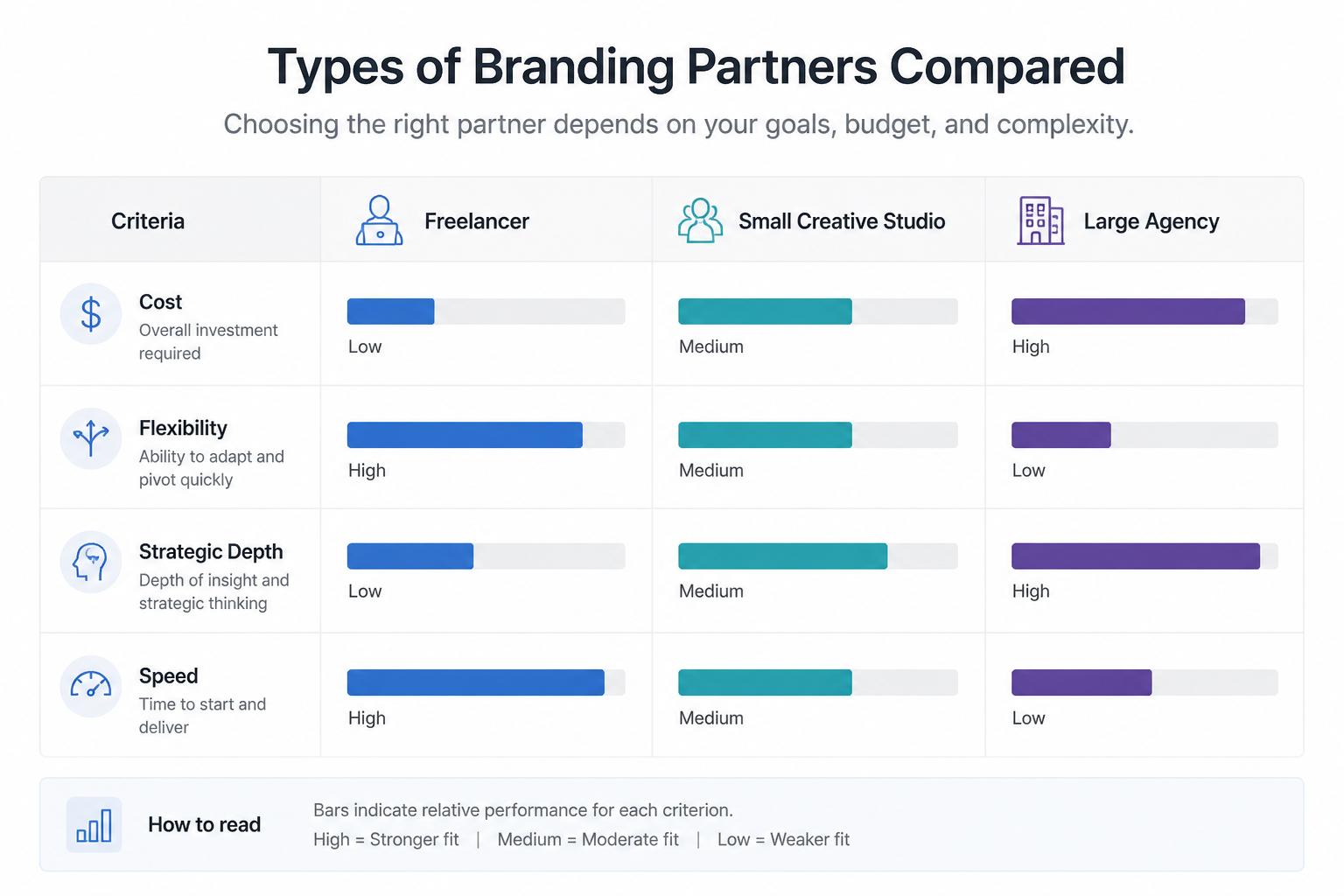
Freelancer vs studio vs agency: comparison
| Partner type | Best for | Pros | Cons |
|---|
| Freelancer | Very early-stage brands, limited scope projects | Lower cost, direct access to talent, flexible | Limited capacity, may lack strategy depth, risk if they get busy or sick |
| Small creative studio | Startups and growing brands needing strategy + execution | Hands-on senior attention, integrated services (identity, web, content), nimble | Capacity limits, may not handle massive global rollouts |
| Large agency | Enterprise, complex multi-market or multi-channel work | Big teams, specialized departments, robust processes | Higher fees, more layers, juniors may do most of the work |
For many founders and consumer brands, a brand identity design studio or digital branding agency hits the sweet spot: strategic enough to think long-term, lean enough to move fast and stay close to your business.
Step 3: Core Criteria for Choosing a Creative Branding Agency
Use the criteria below as a comparison checklist. Score each agency you’re evaluating on a simple 1–5 scale to make the decision more objective.
1. Strategic depth (not just aesthetics)
Branding that looks good but doesn’t move the needle is expensive decoration. Look for signs of true strategy:
They ask detailed questions about your customers, competitors, and business model.
Their case studies connect creative work to outcomes (conversion, engagement, pricing power, etc.).
They talk about positioning, messaging, and audience insight—not only colors and fonts.
Ask to see how they document strategy (brand platforms, positioning frameworks, customer personas, etc.). Agencies like Neu Tribe Studios, for example, build strategy into every identity and digital project rather than treating it as an optional add-on.
2. Category and audience understanding
You don’t need an agency that has done exactly your niche before, but you do want proof they understand:
Consumer-facing brands, if you’re in fashion, lifestyle, or D2C
Digital-first behavior and how audiences discover and trust brands online
Creator–founder hybrids if you’re building a personal or entrepreneurial brand
Ask how they’d research your audience and what they already know about your space. Look for references to modern brand-building and customer journeys, not just traditional advertising.
3. Integrated capabilities vs. fragmented vendors
Strong brand building doesn’t stop at a logo file. When evaluating a branding agency for startups or growth brands, look at how much of the journey they can own:
Strategy: brand positioning, customer and competitor analysis, brand architecture
Identity: visual identity design, logo, typography, color, brand guidelines
Digital: website/UI design, responsive web design, UX flows, content hierarchy
Content & campaigns: photography, video, social media management, campaign design
The more integrated the team, the more consistent your brand will feel across touchpoints—and the less time you’ll spend being the project manager between multiple vendors.
4. Process and collaboration style
A great fit is as much about how they work as what they produce. Ask them to walk you through their process from discovery to launch:
How do they onboard you and extract the right information?
What are the key milestones (strategy, creative directions, refinements, delivery)?
How often will you meet, and who will be in the room?
What tools do they use for feedback and approvals?
Look for a process that is structured but not rigid, with clear points where you can give input without micromanaging every pixel.
5. Quality and relevance of portfolio
When you review portfolios for brand identity design studio selection, don’t just ask “Do I like this?” Instead, ask:
Is there a clear throughline of strong positioning and storytelling?
Can I see how the identity extends into real touchpoints—website, social, packaging, campaigns?
Do they show before/after or context, or just pretty mockups?
It’s a good sign if their work feels diverse in style but consistent in clarity and craft. That suggests they build brands around strategy, not just their own aesthetic preferences.
6. Team seniority and who actually does the work
In discovery calls, clarify who will be hands-on with your project:
Will you work directly with the creative director or senior strategist?
Are juniors supported by experienced leadership, or left to figure it out?
How many projects does the core team run at once?
For high-stakes rebrands, you want senior brains on your business—not just on the pitch deck.
7. Timelines, capacity, and reliability
Ask for realistic timelines and how they handle overlapping projects. Good agencies will:
Build in time for research, iteration, and implementation
Flag up-front if your desired launch date is unrealistic
Explain how they protect quality when things get busy
Reliability is a key part of trust—especially if your brand launch is tied to funding, retail, or PR milestones.
Step 4: Red Flags When Hiring a Branding Agency
As important as your criteria are the warning signs. These creative agency red flags often predict painful projects.
1. They jump to visuals before understanding your business
If the first conversation is all about colors and logos and not about customers, category, and goals, expect a surface-level outcome. Strong agencies slow down at the start so they can move faster later.
2. No clear process or timeline
“We’ll figure it out as we go” is not a process. If they can’t articulate phases, deliverables, and responsibilities, you’ll likely end up managing chaos.
3. Overpromising on speed or price
Brand strategy, visual identity, and digital execution take time. Be wary if:
They promise a full rebrand in a couple of weeks.
They’re dramatically cheaper than comparable studios without a clear reason.
They can start “tomorrow” despite claiming to be in high demand.
Someone will pay the price for that speed—usually quality, depth, or your team’s sanity.
4. Thin or generic case studies
If their portfolio is all mockups with no context, no problem statements, and no outcomes, it’s hard to know what role they actually played. Look for at least a short narrative: the challenge, the approach, and the results.
5. Poor communication in early interactions
Discovery calls are a preview of the relationship. Take note if they:
Show up late or unprepared
Talk more than they listen
Struggle to explain their own work clearly
This rarely improves once you’ve signed the contract.
6. No ownership of implementation
If they only deliver files but don’t support rollout—website, social templates, brand guidelines, content direction—you risk a beautiful but inconsistent brand in the wild. Ask how they help teams implement and protect the brand.
Step 5: Essential Questions to Ask a Branding Agency
The right questions will quickly reveal whether an agency is a good fit. Use this list as a starting point and adapt it to your context.
Questions about strategy and approach
How do you define “brand strategy,” and how does it show up in your work?
Can you walk me through a recent project from brief to launch?
How do you research and understand a new audience or category?
How do you connect branding work to business outcomes?
Questions about process and collaboration
What are the main phases of your process, and what do you need from us at each stage?
Who will be our main point of contact, and who will do the core work?
How do you prefer to handle feedback and revisions?
How do you keep projects on track if priorities shift?
Questions about capabilities and scope
Which parts of the brand journey do you handle in-house (strategy, identity, website, content, social, campaigns)?
Do you offer ongoing support after launch (social media management, content creation, campaign design)?
How do you ensure consistency across channels like packaging, website, and social?
What does a typical engagement look like for a startup or growing brand?
Questions about results and proof
Can you share examples where your work led to measurable impact (engagement, sales, pricing, funding, etc.)?
How do you measure success on branding projects?
Can we speak to a recent client with a similar profile to ours?
What does a successful partnership look like from your perspective?
Questions about pricing and fit
How do you structure your pricing—fixed fee, phases, retainers?
What’s typically included (and not included) in your proposals?
What kind of clients do you do your best work with?
If we had to simplify the scope for budget reasons, how would you prioritize?
Step 6: Comparing Agencies Side by Side
Once you’ve done a few discovery calls, create a simple comparison matrix to keep the decision grounded in facts, not just vibes.
Sample comparison framework
Column 1: Agency name
Column 2: Strategic depth (1–5)
Column 3: Relevant category experience (1–5)
Column 4: Portfolio strength and relevance (1–5)
Column 5: Team seniority on your project (1–5)
Column 6: Process clarity and chemistry (1–5)
Column 7: Integrated capabilities (strategy, identity, digital, content) (1–5)
Column 8: Budget and value alignment (1–5)
You can weight certain criteria higher depending on your priorities—for instance, a branding agency for startups might prioritize speed, flexibility, and founder involvement, while an established brand might weight rollout capability and stakeholder management more heavily.
Step 7: Budgeting and Scope—What Drives Cost
Understanding what drives cost will help you compare proposals more fairly and avoid under-scoping critical work.
Key cost drivers
Depth of strategy: Workshops, research, customer interviews, and positioning work require senior time.
Number of deliverables: Identity only vs. identity + website + social templates + brand guidelines.
Complexity of implementation: Multi-language sites, e-commerce, or heavily customized UX will increase scope.
Content production: Original photography, video, and campaign assets carry production costs.
Ongoing support: Social media management, campaign design, and content creation retainers.
Agencies that are transparent about these levers—and help you phase work intelligently—are more likely to be good long-term partners.
How Digital-First Brands Should Evaluate Agencies
If most of your brand lives online, you’ll want to go deeper on digital branding agency evaluation.
Website and UX capabilities
Ask to see examples of websites they’ve designed and built (or designed in collaboration with developers). Evaluate:
Clarity of messaging and hierarchy
Mobile experience and speed
Conversion-focused design (CTAs, flows, forms)
Cross-check their thinking with resources like the Nielsen Norman Group’s UX guidelines to see if they’re aligned with best practices—not just trends.
Content, social, and campaigns
Modern brands are built in the feed as much as on the homepage. When choosing a creative branding agency, look for:
Examples of ongoing content creation for brands, not just one-off posts
Social media management services where they own both strategy and execution
Campaign design that connects visuals, copy, and channel strategy
Ask how they adapt brand systems for platforms like Instagram, TikTok, and email while keeping everything recognizably “you.”
Making the Final Decision
At this point, you should have:
Clear goals and success metrics
A shortlist of 2–3 agencies with proposals
Notes from discovery calls and your comparison matrix
Now, zoom out and ask:
Which team seems to understand our customer and business the best?
Who has shown the most clarity in process and communication?
Where do we feel the strongest sense of creative and strategic chemistry?
Remember: branding is a collaborative, sometimes vulnerable process. The right partner is the one you trust to challenge you, push your thinking, and still feel like they’re on your side.
When Neu Tribe Studios Might Be the Right Fit
If you’re a founder, entrepreneur, or growing consumer brand and you’re looking for a partner that bridges strategy and creative execution, a studio like Neu Tribe Studios can be a strong fit when:
You’re launching or rebranding and need strategy, visual identity, and digital presence built as one system.
You want brand storytelling, photography, and content that feel editorial, not generic.
You value having a small, senior team that knows your business deeply and stays involved from workshop to launch.
Whether you choose Neu Tribe Studios or another partner, use this framework to approach choosing a creative branding agency as a strategic decision—not a quick aesthetic one. The right choice will pay you back in clarity, confidence, and a brand that actually moves your business forward.
“Your brand is the single most important investment you can make in your business.” – Steve Forbes
Ground your investment in clear criteria, honest conversations, and a partner who understands where you’re going—not just where you are today.