You can have the best product in your category and still feel invisible.
If your fashion label, lifestyle brand, or D2C startup is posting daily, tweaking ads, and chasing trends but not seeing real traction, the problem usually isn’t effort. It’s the lack of a clear, simple brand strategy.
This guide breaks down brand strategy basics into a practical, no-fluff framework you can actually use. You’ll learn how to define your audience, sharpen your positioning, and turn your story into a brand that customers remember, buy from, and talk about.
Whether you’re pre-launch or already selling, use this as your playbook to build a stand-out consumer brand from the inside out.
What is brand strategy (and why does it matter so much)?
Brand strategy is the blueprint for how your brand shows up in the world—who you’re for, what you stand for, how you’re different, and how you communicate that consistently across every touchpoint.
It’s not just a logo, color palette, or tagline. Those are outputs of strategy, not the strategy itself.
A strong brand strategy answers questions like:
Who exactly are we building this for?
What problem or desire are we really solving?
Why should someone choose us over 20 similar options?
What do we want them to feel and remember after every interaction?
For consumer brands—especially in fashion, lifestyle, beauty, wellness, and D2C—strategy is your competitive edge. Products can be copied; positioning, story, and emotional connection are much harder to replicate.
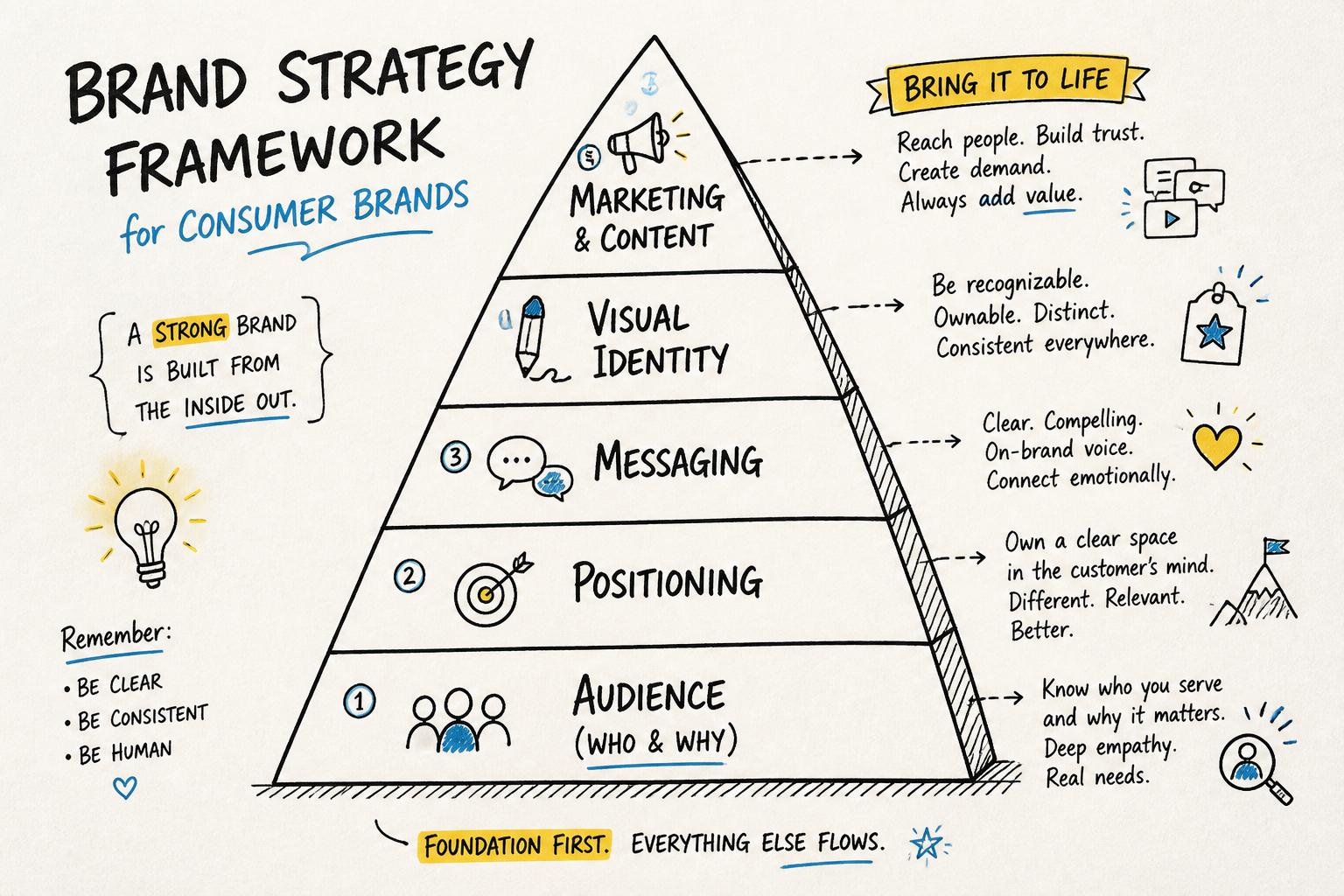
The 5-part brand strategy basics framework
To keep things practical, we’ll use a simple five-layer framework you can work through step by step:
Audience: Who you’re for
Positioning: Where you sit in the market
Messaging: What you say and how you say it
Visual Identity: How you look
Marketing & Content: How you show up consistently
Think of it as building from the inside out: clarity first, aesthetics second. Let’s walk through each layer.
1. Audience: Know exactly who you’re talking to
Every strong brand strategy starts with a sharp understanding of your audience. Not “women 18–35” or “millennials who like fashion” but a specific, lived-in picture of the people you serve.
Shift from demographics to real people
Demographics (age, income, location) are useful, but they don’t tell you why someone would care about your brand. You need to understand:
Contexts: When and where do they encounter your product? (On the go, at home, at events?)
Motivations: What are they trying to express or solve? (Confidence, status, comfort, sustainability?)
Frustrations: What annoys them about current options? (Fit, shipping, ethics, originality?)
Beliefs: What do they value? (Craft, minimalism, boldness, community?)
These insights fuel everything from brand positioning for startups to your content ideas and campaigns.
How to quickly validate your audience
If you’re early-stage or bootstrapped, you don’t need a massive research budget. Start with:
Customer interviews: Talk to 5–15 ideal customers. Ask about their routines, frustrations, and how they currently solve the problem.
Review mining: Read reviews on competitor sites, marketplaces, and Reddit. Note repeated complaints and compliments.
Social listening: Observe how your audience talks on TikTok, Instagram, and niche communities.
Translate what you learn into 1–3 simple audience profiles—not fluffy personas, but short, clear descriptions of your real buyers.
2. Positioning: Claim a clear space in the market
Once you know who you’re for, you can decide how you want to be perceived relative to other options. This is your brand positioning.
Classic positioning asks you to fill in a sentence like:
For [audience], [brand] is the [category] that [core benefit] because [reason to believe].
It looks simple, but getting it right forces hard, strategic choices.
Positioning examples for consumer brands
Here are a few simplified examples:
Fashion: For style-conscious professionals in cities, we are the workwear brand that makes getting dressed effortless because every piece is designed to mix-and-match in a compact wardrobe.
Beauty: For ingredient-aware skincare lovers, we are the clean beauty brand that delivers visible results in 30 days because our formulas are clinically tested and dermatologist-developed.
Home & lifestyle: For first-time homeowners, we are the decor brand that makes styling your space feel easy because we provide curated room bundles instead of single products.
Good positioning is specific, believable, and different. If a competitor could copy-paste your line and it still works, it’s not sharp enough.
3 lenses to sharpen your positioning
To refine your brand positioning for startups, look at three angles:
Customer truth: What do they actually care about most?
Competitive gap: Where are others under-serving or over-complicating?
Founder edge: What do you know, believe, or do differently that others can’t easily copy?
Your positioning sits where those three overlap.
3. Messaging: Turn your strategy into words people remember
Messaging is where your strategy starts to feel real. It’s the language system that shapes how you talk about your brand everywhere: website, packaging, social, ads, founder interviews, and even customer service.
A simple brand messaging strategy has four core elements:
Brand promise: The core outcome or transformation you deliver.
Key messages: 3–5 supporting points that prove your promise.
Proof points: Evidence—materials, process, data, testimonials—that back each key message.
Voice & tone: How you sound (e.g., bold, warm, playful, minimal).
Craft a clear brand promise
Your brand promise should be simple and benefit-led. For example:
“Effortless outfits for real life.”
“Serious skincare without the 10-step routine.”
“Design-forward home essentials that don’t break the bank.”
Use this line as a north star for your headlines, product descriptions, and social bios.
Build your message hierarchy
Think of your messaging like a pyramid:
Top: Short, punchy hook (what grabs attention).
Middle: Key benefits and reasons to believe (what convinces).
Bottom: Details, specs, FAQs (what reassures).
On your website, social captions, and ads, lead with what matters most to your audience—not with your origin story or product features.
4. Visual identity: Make your brand instantly recognizable
Once your positioning and messaging are clear, you can design a visual identity that actually supports your strategy instead of just looking “cool.”
Visual identity includes:
Logo and wordmark
Color palette
Typography
Imagery style (photography, illustration, art direction)
Graphic elements (icons, patterns, layouts)
Packaging design, if you’re a physical product brand
The goal isn’t to follow every trend on Instagram. It’s to create a cohesive, recognizable system that feels like you, across every touchpoint.
Translate strategy into visuals
Use your strategy to guide visual decisions:
If your promise is about calm and simplicity, you might lean into soft neutrals, generous whitespace, and clean typography.
If your brand is about bold self-expression, you might choose high-contrast colors, dynamic layouts, and expressive type.
If you emphasize sustainability and craft, you might use natural textures, warm tones, and documentary-style photography.
This is where partnering with a brand identity design studio or creative branding agency can help you avoid generic aesthetics and build a system you can grow with.
5. Marketing & content: Show up with intention, not noise
With your strategy, messaging, and identity in place, you can finally show up consistently—without feeling like you’re guessing every time you post.
Your goal here is to build a consumer brand strategy that turns casual scrollers into loyal customers over time, not just chase short-term clicks.
Choose your core channels
As a fashion, lifestyle, or D2C founder, you don’t need to be everywhere. You need to be consistently great in a few places. For most consumer brands, that looks like:
Owned: Website, email list, maybe SMS.
Social: 1–2 primary platforms where your audience actually hangs out (often Instagram, TikTok, or Pinterest).
Search: Basic SEO on your site so people can find you when they’re ready to buy.
From there, you can layer in social media marketing for startups, influencer partnerships, and paid ads once your foundations are solid.
Build a simple content strategy
Strong brands don’t just post product shots. They create content that supports their positioning and promise. Aim for a mix of:
Brand story content: Founder story, behind the scenes, values, process.
Educational content: How-tos, styling tips, routines, care guides.
Social proof: Customer reviews, UGC, press features.
Launch & offer content: New drops, limited editions, bundles.
Use your brand messaging strategy to keep this content on-theme instead of random.
Brand differentiation: How to actually stand out
In crowded consumer categories, “high quality” and “great customer service” are table stakes. To stand out, your brand differentiation needs to be clear and meaningful.
5 ways to differentiate your consumer brand
Audience focus: Serve a specific niche deeply instead of trying to please everyone.
Point of view: Take a clear stance on style, values, or culture. Bland is forgettable.
Experience: Make unboxing, shopping, and support feel noticeably better than competitors.
Product system: Design products that work together (capsule wardrobes, bundles, routines).
Story: Share the real “why” behind your brand and make customers part of it.
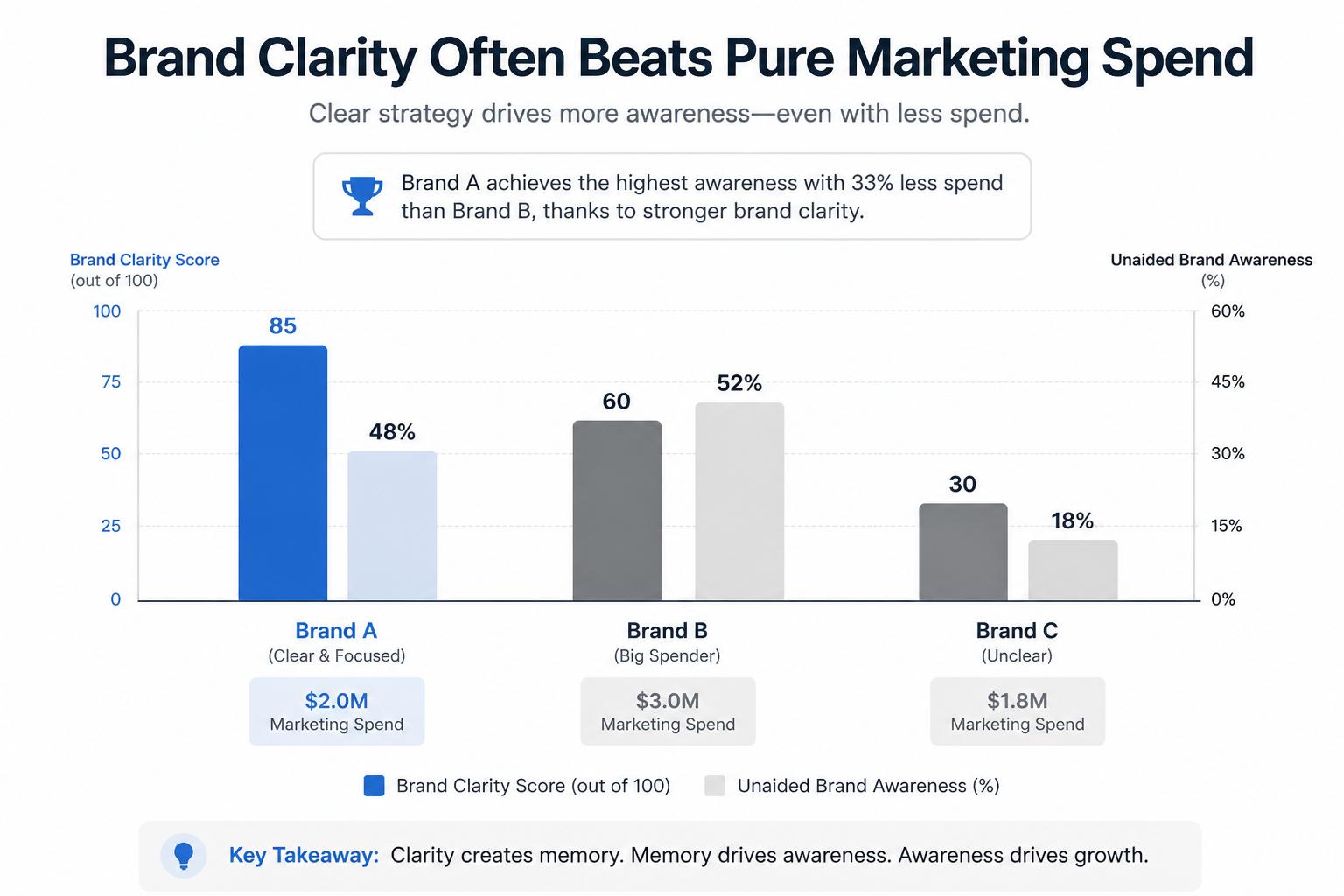
Research from McKinsey on creative effectiveness shows that brands that invest in distinctive, consistent creative outperform peers in revenue growth. Differentiation isn’t just nice to have—it’s a growth lever.
Putting it together: A simple brand strategy framework you can use today
Here’s how to apply these brand strategy basics in a structured way, even if you’re a solo founder or small team.
Step 1: Clarify your audience and problem
Write 1–3 short audience descriptions based on real people you know or have spoken to.
List the top 3 frustrations they have with current options.
List the top 3 desires they’re really chasing (status, ease, confidence, belonging, etc.).
Step 2: Draft your positioning statement
Fill in the positioning formula: For [audience], [brand] is the [category] that [core benefit] because [reason to believe].
Test it with a few ideal customers. Does it feel clear and compelling? What would they change?
Step 3: Define your brand promise and 3–5 key messages
Write one sentence that captures the main transformation you deliver.
Underneath, write 3–5 key messages that support that promise.
Add at least one proof point under each message (material details, data, process, testimonials).
Step 4: Translate into a starter visual direction
Collect 15–20 reference images (not just competitors) that feel like your brand.
Note what you like about each: color, energy, composition, typography, photography style.
Share this with a designer or visual identity design partner to build a cohesive system.
Step 5: Build a 30-day content and brand rollout plan
Choose 1–2 main platforms to focus on.
Plan 3–4 content pillars based on your strategy (e.g., education, story, social proof, launches).
Map 12–20 content ideas that reinforce your positioning and key messages.
Research from Bain & Company on customer experience shows that brands that deliver consistently strong experiences grow revenue up to 4–8% above the market. Consistency is where your strategy turns into real brand equity.
Common mistakes founders make with brand strategy
Even smart founders fall into a few predictable traps when they’re figuring out how to build a brand strategy.
Starting with the logo: Design without strategy leads to expensive rebrands later.
Trying to be for everyone: Broad positioning feels safe but kills memorability.
Copying category leaders: You end up as a weaker echo of someone else’s brand.
Inconsistent execution: Changing tone, visuals, or story every few months confuses customers.
Neglecting retention: Focusing only on acquisition instead of building loyalty and community.
According to Gartner’s research on customer loyalty, emotionally engaged customers are more likely to recommend and repurchase. Brand strategy is how you intentionally build that emotional connection.
When to DIY and when to bring in a brand strategy agency
Early on, many founders DIY their strategy—and that’s fine. You’re close to the product, the customer, and the vision. But there are key moments when partnering with a brand strategy agency or digital branding agency can save you time, money, and missteps.
DIY makes sense when:
You’re validating an idea and need a fast, lean launch.
You have a small but passionate audience and want to test positioning.
You’re comfortable iterating in public and refining as you go.
Bring in experts when:
You’re preparing for a major launch, rebrand, or funding round.
Your brand feels scattered across channels and you need a cohesive system.
You’re investing in packaging design services, website design, and campaigns and want everything aligned.
You’re ready to scale and need a strategy that can grow with you.
A good partner will combine customer & competitor analysis, brand positioning services, brand storytelling services, and creative execution so your strategy doesn’t stay stuck in a deck.
How Neu Tribe Studios can support your brand strategy
At Neu Tribe Studios, we work with fashion, lifestyle, and D2C founders to bridge the gap between brand strategy and execution.
Depending on where you are in your journey, that can look like:
Clarifying your positioning, audience, and messaging so you can make confident decisions.
Designing a cohesive brand identity—logo, color, typography, and visual systems that reflect your strategy.
Building or refreshing your website with strategic UI/UX design and storytelling.
Creating on-brand content—photography, video, campaigns, and social media management—that keeps your presence consistent.
If you’re ready to move beyond random tactics and build a brand that actually stands for something, a clear strategy is your starting line—not a nice-to-have.
Next steps: Turn these brand strategy basics into action
To recap, a strong consumer brand strategy doesn’t have to be complicated. Focus on:
Audience: Know exactly who you serve and what they care about.
Positioning: Claim a clear, specific place in the market.
Messaging: Build a language system that tells your story consistently.
Visual identity: Design a recognizable look that reflects your strategy.
Marketing & content: Show up with intention across the right channels.
Start by blocking out a half-day to work through the five steps in this guide. Get your thoughts out of your head and into a simple, shareable brand strategy framework you can use with your team, collaborators, and future partners.
And if you want a strategic partner to help you sharpen, stress-test, and bring your brand to life across identity, content, and digital, Neu Tribe Studios is built for exactly that.